
Production of Green Tea in Japan
Green tea production is a long process, including the growing of tea bushes and the processing of tea leaves. Tea leaf processing is divided into two steps, the primary processing of freshly picked tea leaves into crude tea, and the finishing process in which crude tea is made into final tea leaves.
We have divided our overview into three sections, “Tea Growing Region“ and “Cultivation Method”, “Production Process”.
Tea Growing Region

Main Tea Growing Regions in Japan
Of Japan's 47 prefectures (provinces), Shizuoka and Kagoshima are the two major tea-producing regions. Shizuoka, located in the area between Mt. Fut and the Pacific coast west of Tokyo, is Japan's most prolific tea-growing region, accounting for about 40% of Japan's commercial production each year. Next is Kagoshima, in southern Kyushu in the far southwest of Japan's main archtpelago, which produces over 30% of Japan's tea.
Other important tea-growing regions Include the areas of Mie, In central Japan, famous for its long history of tea cultivation, and the anclent capitals - Nara and Kyoto - where Japanese Buddhism has its roots, and various parts of Kyushu, with its comparatively mild climes.
Japanese Green Tea Cultivation Method
How Tea Bushes Are Raised

1. Raising seedlings
Tea plants are usually propgated from cuttings. Although the time of year at which cuttings are taken varies somewhat depending on the region and cultivar variety, June is the normal time in the case of summer cuttings and September to October is the standard time for autumn cuttings. Usually, two-year-old seedlings are transplanted to their final location in the tea plantation. Paper pots (internal diameter: 5-6cm; depth: 15cm) are also used. In the case of potted seedlings, they are usually transplanted to the plantation after six months.

2. Fixed planting - transfering seedlings from the nursery to their permanent place in the field
March to April is the usual time for fixed planting. Several months before the seedlings are transplanted, underground irrigation tubes are laid and the soil is prepared through the application of compost and by deep plowing.*
* Deep plowing: Surface soil and subsoil is tilled (turned over) to a depth of approximately one meter and mixed together. This is said to improve the condition of soil beneath the tea bushes, which is difficult to condition after the tea plants are planted in their fixed position.

3. Management of the young tea bushes
It takes between four and eight years for the newly planted seedlings to reach maturity. Usually from the second year bushes are trained into the desired shape. Through pruning, the height of the main trunk is curbed and lateral branch growth is promoted. The objective of the pruning is to obtain even foliage cover at an early stage and expand the picking surface area. In the case of the Yabukita tea plant cultivar variety, pruning is done to a level of 15-20cm in the second year after fixed planting, 25-30cm in the third year and 35-40cm in the fourth year. In addition, because the young bushes have wide spacing between the rows, it is easy for weeds to grow rapidly. By laying PVC mulch sheeting or straw, the ground surface is covered, making it difficult for weeds to become established. Other weed control methods include tilling the surface soil, while the weeds are still small, to cut the weed roots.

4. Tea picking
Although it becomes possible to pick the tea leaves from the fourth year, it is not until the fifth to eighth years that the width of the bushes and number of shoots provide stable yield and quality.* In regions such as Nansatsu in Kagoshima Prefecture that have a high number of pickings per year, there are five pickings annually - from Ichibancha to Yobancha plus Shutobancha. However, for Gyokuro and other bushes that use a natural shape, only one picking per year - Ichibancha - is carried out.
* Width of the bushes: Width of each row of tea bushes excluding the spacing between each row. For plantations using a conventional layout, this width is usually approximately 170cm.
Tea Raised through WorkDone over a Year

Tea Plantation's Annual Work Cycle
Times of year indicated are based on a plantation in central Shizuoka Prefecture
The number of annual hours of work required on a tea plantation per 10 ares (1,000㎡) is approximately 120 hours in Shizuoka Prefecture and 80 hours in Kagoshima Prefecture, the latter of which uses more mechanization. This work, in addition to picking, includes applying fertilizer, pest control, pruning and bush shaping, and for plantations that grow Kabusecha it is necessary to undertake cover culture-related work.
Japanese Green Tea Production Process
There are a variety of operations and processes involved in manufacturing Japanese green tea, from tea field cultivation to tea factory processing, and our highly-skilled team of experts are dedicated to the art of growing and making tea.
Tea fields to Crude tea (Aracha)
At factories in the areas where tea is grown, freshly picked raw tea leaves are processed into the semi-finished product of crude tea. Crude tea is not usually sold to end users since the leaves are of non-uniform size and shape, and they contain too much moisture and have a "grassy" aroma.
1. Picking
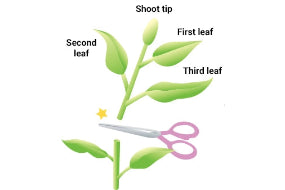
When picking Sencha tea by hand, usually stems with a shoot and two or three opened leaves are picked. When picking by machine, usually the picked stems have a shoot and four or five opened leaves. The freshly picked raw tea leaves are still alive and breathing, and give off heat.

2. Fanning and humidifying
If the freshly picked leaves are left as they are, they immediately begin to ferment and heat up. To prevent loss of quality and maintain freshness, the raw leaves are fanned with damp air to help maintain their moisture and dissipate the heat given off by the fresh leaves.

3. Steaming
The tea leaves are steamed with non-pressurized steam to stop oxidation, preserve their green color, and remove grassy notes. Steaming time strongly influences flavor, aroma, and color: longer steaming breaks down cell membranes more easily, causing cloudiness but increasing luster while reducing astringency and fragrance.

4. Cooling
If the steamed tea leaves are left at high temperature, they will lose their bright color and their flavor and aroma will be spoiled. For these reasons, to preserve the tea's luster and color as well as flavor and aroma, air is blown over the steamed leaves to rapidly cool them to normal room temperature.
5. Pressing
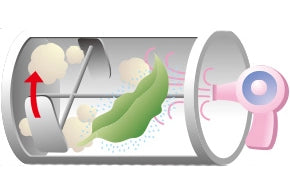
To enhance luster, color, flavor and aroma, and shorten the first rolling stage, the leaves are pressed while being exposed to dry, hot air from a fan to remove moisture. (This process removes steam dew from the leaves' surface and increases the drying effect.)
6. First rolling
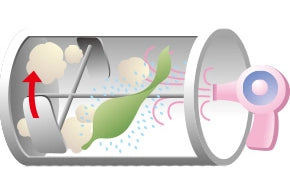
To soften the leaves and lower the internal moisture content, hot, dry air is blown over the leaves while applying pressure and appropriate friction and compression.

7. Rolling and twisting
The leaves are pressed in a bundle without applying heat to break up their structure and make it easier for the components of the tea leaves to be released when it is made into tea. This process also compensates for any lack of pressing during the first rolling process and moisture content is made uniform.

8. Second rolling
Since the tea leaves wither after rolling and twisting and are still relatively high in moisture and uneven in size and shape, they are rolled while having hot, dry air blown on them. They are then dried and disentangled ready for final rolling.

9. Final rolling
To give the tea leaves their characteristic needle shape, they are rolled in one direction only, similar to the action of manual rolling, while further reducing moisture content.

10. Drying
The leaves have a moisture content of approximately 10-13% after final rolling, and this is reduced to 5% with hot-air drying. This allows long-term storage and further draws out their distinctive aroma.
Crude tea to Final products
Crude tea is uneven in shape and its moisture content is still high, meaning it can easily deteriorate. For these reasons, crude tea does not yet have the value of a finished product. Consequently, it requires secondary processing before it can be sold as a finished product. This enables it to be stored and allows the final product to be adapted to local consumer tastes. Its value as a final product is increased by both appearance and content. This process is so important that each company within the tea manufacturing industry keeps it a secret.
Secondary processing involves drying, sorting, cutting and shaping, and grading using blown air and electrical sensitivity. Blending is carried out according to tastes in the consuming region and price. Specific methods and procedures are extremely complex and vary depending on the factory at which they are performed. Broadly speaking, there are two main approaches. Under the pre-roasting method, the crude tea is roasted, sorted, and shaped, while under the post-roasting method, the crude tea is first shaped and sorted according to shape and weight and is then roasted to the optimum level for each size.